
A gentle pathway to self‑rescue skills
Our program introduces babies and toddlers to the water in short, focused sessions that emphasize effective breathing, rolling to float, and safe, supervised skill development. Each child progresses at their own pace with consistent, encouraging instruction.
Breath control & relaxed submersion
Roll‑to‑float with independent recovery
Swim‑float‑swim sequencing for toddlers
Parent water-safety education and child’s skill progression updates.
What will your child learn
Through short, consistent lessons, your child can learn essential survival skills and build a strong foundation for lifelong confidence in the water. Each lesson is one-on-one and tailored to your child’s comfort and developmental readiness. We use positive reinforcement to celebrate progress at every step. A parent or caregiver observes each lesson poolside.
In the final week, students practice fully clothed to better simulate real-life accidental water entry. Most children complete ISR skills in approximately 5–8 weeks (or about 30 lessons), though timelines vary by child.
Types of lessons
Two core skill sequences, based on age and developmental readiness.
Infants (typically 6–12 months)
Babies who are crawling learn breath control, correct floating posture, and how to roll to a back float and maintain it for increasing periods of time.
Your child must be crawling and/or able to sit up independently and maintain a sitting position for one minute.
Toddlers + Children (typically 1 year and older)
Children old enough to walk and developmentally ready will will learn to swim face-down using arms and legs, roll to a back float when they need air, and then roll back over to continue swimming.
Instruction uses sensorimotor learning, behavioral principles, and positive reinforcement, along with ISR safety protocols designed to support safe, effective learning.
Recommended at least every 6 months
If your child has previously completed ISR Swim-Float-Swim lessons, refresher lessons are recommended every six months (or sooner if needed) to help maintain strong self-rescue skills.
Because children grow and change quickly, periodic practice helps ensure skills stay effective as their bodies develop. Refresher sessions typically take only a few weeks to complete.
Weekly or twice monthly
After your child completes ISR, ongoing weekly or twice-monthly lessons help keep skills sharp. These sessions give your child regular practice and allow us to correct any habits picked up outside of lessons.
Infants (typically 6–12 months)
Babies who are crawling learn breath control, correct floating posture, and how to roll to a back float and maintain it for increasing periods of time.
Your child must be crawling and/or able to sit up independently and maintain a sitting position for one minute.
Toddlers + Children (typically 1 year and older)
Children old enough to walk and developmentally ready will will learn to swim face-down using arms and legs, roll to a back float when they need air, and then roll back over to continue swimming.
Instruction uses sensorimotor learning, behavioral principles, and positive reinforcement, along with ISR safety protocols designed to support safe, effective learning.
Infants (typically 6–12 months)
Babies who are crawling learn breath control, correct floating posture, and how to roll to a back float and maintain it for increasing periods of time.
Your child must be crawling and/or able to sit up independently and maintain a sitting position for one minute.
Toddlers + Children (typically 1 year and older)
Children old enough to walk and developmentally ready will will learn to swim face-down using arms and legs, roll to a back float when they need air, and then roll back over to continue swimming.
Instruction uses sensorimotor learning, behavioral principles, and positive reinforcement, along with ISR safety protocols designed to support safe, effective learning.
Meet the instructor
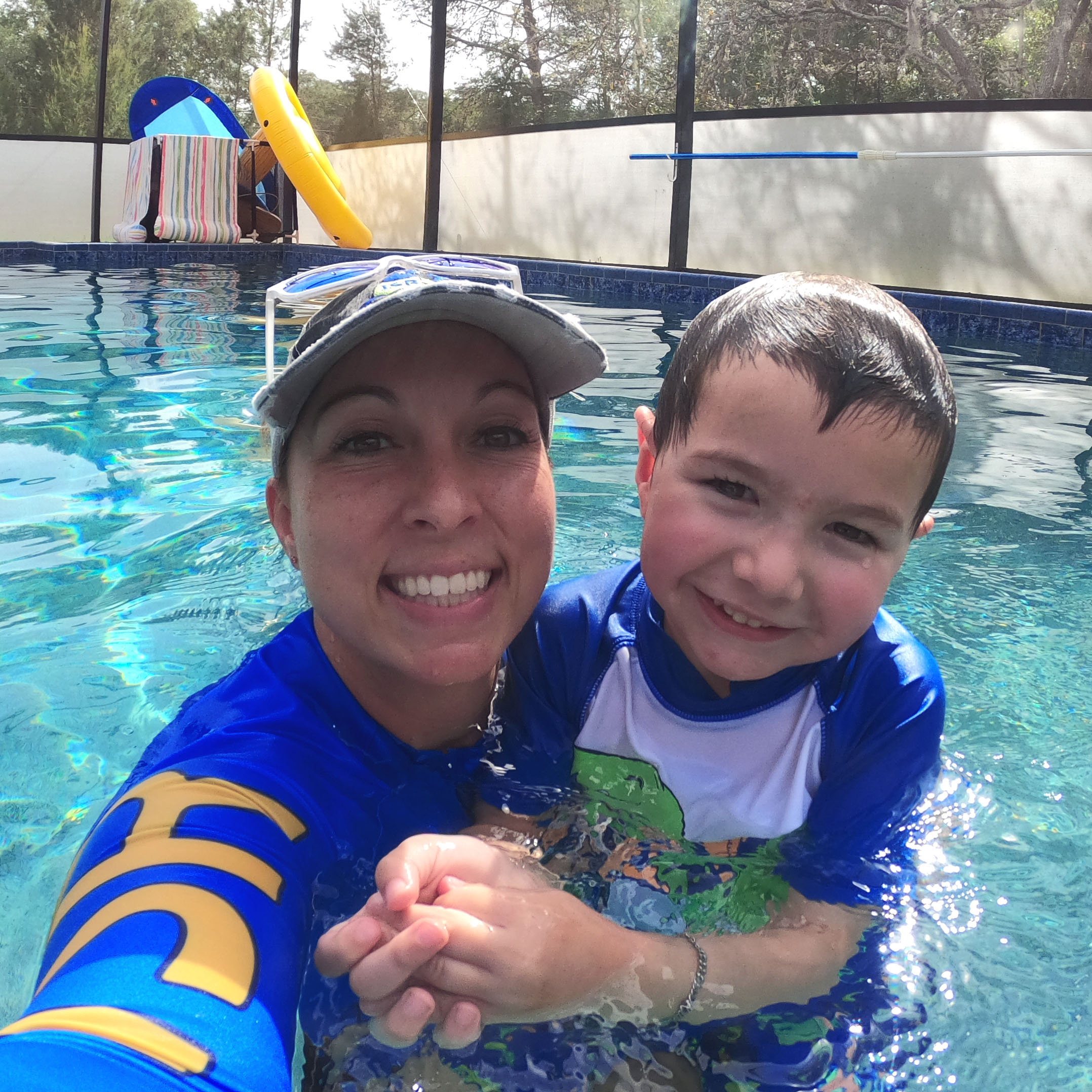
I was born and raised in Florida and live in New Port Richey with my husband and our two daughters. I discovered ISR in 2010 after seeing a friend’s child demonstrate self-rescue skills, and I knew immediately this was something every child should learn.
After my daughter completed lessons, I was inspired by my instructor’s dedication and decided to change careers. In 2013, I became a certified ISR Instructor, completing extensive in-water training and coursework in behavioral psychology, anatomy, physiology, and ISR techniques.
Teaching ISR continues to be incredibly rewarding. There is nothing more important than a child’s safety, and these skills provide families with peace of mind and an additional layer of protection. I am proud to serve our community and look forward to meeting you and your child.
Water safety
Even if your child has had swimming lessons, no child is drown-proof and there is absolutely no substitute for adult supervision. Drowning is the leading cause of accidental death for children between the ages of one and four. At ISR, we believe in layers of protection because we know that sometimes supervision fails.
#1
Effective SupervisionEffective Supervision
The most critical line of defense is adult supervision. No level of aquatic skill can replace active supervision. If your child is ever missing, look in the water first.
#2
Pool FencesInstall a permanent 4-sided fence with self-locking gates. Ensure that the pool fence is at least 3-5 feet from the pool edge.
#3
AlarmsAlarms
Make sure all doors and windows leading to the pool are locked and alarmed.
#4
Swimming LessonsSurvival Swimming Lessons
ISR’s Self-Rescue training is an added layer of protection, teaching your child water survival skills in a completely safe environment.
#5
CPRCPR
If an emergency happens, it is essential parents and families are prepared. Learn to perform CPR on children and adults and remember to update those skills regularly.
ISR’s Family Aquatic Safety List
Locations and schedule
Lessons are conducted from March through the end of October at a private heated pool in Golden Acres, located off Little Road and Jasmine Blvd in New Port Richey. The schedule below is subject to change based on availability and demand.
What parents are saying
“ Liona is awesome. We watched our little learn new skills daily with Liona. If there was an issue with the way our little was doing something, Liona found a way to help her understand and worked through the speed bump with her. 10/10 recommend!”
“ Our daughter had a great experience with Liona. She exceeded our expectations with her teaching style. She definitely knows how to gain the kids’ trust to help them try new things and makes the lessons enjoyable. We are very satisfied and highly recommend her.”
“I cannot recommend Liona enough! So knowledgeable and is excellent at making both the parent and child feel safe in the water. As a first time mom I needed all of the comfort and guidance when it came to my daughter. Liona provided that and SO MUCH MORE!”
Frequently asked questions
Ready to book lessons?
Send a quick note with your child’s age and preferred schedule. We’ll reply with current availability, location options, and next steps.